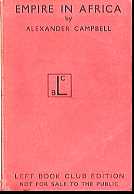
Empire in Africa
Campbell, Alexander
1944
- Publisher: Victor Gollancz Ltd. London
- Edition: Left Book Club Edition (not for sale to the public)
- ISBN: n/a
- Our classification: History
- Found: s/h Oxford 1996 "3.50
Book ID 299
Book ID 299
See also
Campbell, Alexander Empire in Africa, 1944
Extract Date: 1913 and before
The natives of Tanganyika began to grow Coffee before 1913 - during the period of German rule.
See also
Campbell, Alexander Empire in Africa, 1944
Extract Date: 1922
There were fewer than 600 native planters in 1922;
See also
Campbell, Alexander Empire in Africa, 1944
Extract Date: 1944
Arusha, in a country of bush and big game, primitive tribes and volcanic hills, has the distinction of being in the exact centre of Africa - 2,450 miles from Cape Town, and 2,450 miles from Cairo.
See also
Campbell, Alexander Empire in Africa, 1944
Extract Date: 1944
now [1944] there are about 12,000 native planters and 200 European planters. There is a friction between the two. The Europeans have repeatedly alleged that the natives fail to keep down the pests and the weeds. A Government expert investigated this charge. He reported that in the Kilimanjaro area conditions on the native plantations were better than on the white plantations. The buyers evidently think so too, for before the war the natives were getting the same, and in some cases higher, prices than the whites.
See also
Campbell, Alexander Empire in Africa, 1944
Extract Date: 1944
Tanganyika's debt charges amount to a quarter of the total revenue. Two-thirds of the money borrowed was spent on railways. In addition to the debt charges, there are heavy fixed administration charges to be faced on account of Government and social services - costs whose burden on a large, undeveloped territory, where native health is poor and civilisation is scarcely begun, looms all the larger when foolish extravagances like Government House are remembered.
See also
Campbell, Alexander Empire in Africa, 1944
Extract Date: 1944
The national anthem is sung to the tune of 'Clementine' - Tanganyika, Tanganyika, oh my DARling Clementine. The country is three times the size of the United Kingdom. Largest and most populous of all the British East African territories, it has 5,000,000 Africans, 23,500 Indians and 9,000 Europeans.
See also
Campbell, Alexander Empire in Africa, 1944
Five miles of road cover 2,500 vertical feet to the lower forest limit. This road was built by the Chagga tribe, to the facilitate the marketing of their coffee. They did the whole thing unaided, estimating the gradients entirely by eye. The result is an excellent motor road.
